Welcome!

This blog provides a forum for presenting and discussing the latest findings relating to the ancient Indian Ocean, from archaeology, molecular genetics, historical linguistics and other disciplines. It takes a long-term view of the Indian Ocean region, exploring the processes that shaped its cultures, societies and environments from the Pleistocene to the historical period.

We welcome your ideas, inputs and views. Please provide news of relevent publications, conferences, meetings, and other events.
Showing posts with label Archaeology. Show all posts

Thursday, 21 February 2013

Crop translocation modes and motivations

A few months ago, some of the SEALINK project members, put out a paper in World Archaeology, "Old World Globalization and the Colombian Exchange: comparions and contrast." While this paper is ostensibly a critique of the paper a year early by our colleagues in Cambridge (Jones & al Food Globalization in Prehistory), that is really only a starting point for a conversation of how and why crop spread at apparently quite early dates. While Jones et al propose that one mechanism was a desire for calories, i.e. a need to produce more staple foods, with a preference for easy to grow crops, we have taken issue with this suggesting instead that in many cases, perhaps in most cases, initial translocation of crops was small scale, experimental, and unlikely to have been of much subsistence importance. There are a few evidential problems we have catalogued, like dubiously early (Neolithic) dates for millet or buckwheat in Europe that  really are not supported by recent systematic archaeobotanical work in Europe. This paper also includes an updating mapping of the eastward spread of wheat and its associates (barley, but also lentil, pea, etc.) into China and India. This aspect of the paper I have noted on the archaeobotanist blog, in relation to the eastern extensive of crop spread from the Near East. However, it is the contrasts between India and China, which I think are most interesting. The Near Eastern crops as a group were much more important in India, although gradually and with distance this became less the case, while in the China it is only wheat at arrives early and it really appear unimportant. Indeed historical sources point to its importance arising in much later periods. While both region get wheat at around the same time (later 3rd millennium BC), the patterns of uptake are very different, implying differing social motivations. This leads to what I consider the most important part of the paper, the start of a discussion of how we should classify crops, in terms of value, both social and economic, and how crops change in value with time and context. Thus one culture staple crop is another culture exotica or cash crop, and where a crop fall in this schema, whether available in bulk or rare, locally or imported, changes over time. We would like to see this as the start of a new way thinking about how foodstuffs and crops fit into the borader patterns of social interaction both locally and long-distance.

Friday, 18 May 2012

Royal Asiatic Society of Sri Lanka Lecture

Out of Africa and the Significance of the South Asian Archaeological Record,
By Prof. Michael D. Petraglia Professor of Human Evolution and Prehistory, University of Oxford.
on 24 May 2012 17:00

More Information

Wednesday, 2 May 2012

NATURE | NEWS FEATURE Human migrations: Eastern odyssey

Humans had spread across Asia by 50,000 years ago. Everything else about our original exodus from Africa is up for debate.

Excavation at Jwalapuram Locality 22, Jurreru Valley, India.  Middle Palaeolithic artefacts were found under the Toba ash.
For the full story in Nature, click here

Tuesday, 1 May 2012

Ancient network of rivers and lakes found in Arabian Desert

Satellite images have revealed that a network of ancient rivers once coursed their way through the sand of the Arabian Desert, leading scientists to believe that the region experienced wetter periods in the past.  See:  Click here for more information

Tuesday, 14 February 2012

Monsoon aridification over Holocene South India & agricultural adaptation


[from the archaeobotanist] A new article, out this week in Geophysical Research Letters,"Holocene aridification of India", by, Ponton, Giosan, an others, presents important new, and quite high resolution, data on past monsoon dynamics and vegetation of peninsular India spanning the whole Holocene. This research, lead by researchers from the Woods Hole Oceanographic Institute, analyzed evidence from a Bay of Bengal sediment core, which captures discharges from the large Godavari river system. The core data comes from carbon isotopes of leaf waxes, reflecting the amount of arid-adapted/ savannah vegetation in the Godavari catchment, and oxygen isotopes from a marine microfossil that record salinity. This points to a general aridification trend over the course of the middle and late Holocene, supporting what we already would infer from pollen data in Rajasthan or monsoon proxies in the Arabian Sea, but this time providing more direct evidence from South India. My own involvement in this work came in the form of trying to think about how this might be correlated with archaeological evidence for settlement, agriculture and population in South India-- where the archaeological record suggests increasing sedentism, population and agriculture in response to, or despite, aridification, a contrast from the Indus region for example where the long-term trend of population depletion as aridification proceeded. This suggests long term cultural adapatation processes to aridification in peninsular Indian agricultural practices.


To quote from part of our conclusion: "The significant aridification recorded after ca. 4,000 years ago may have spurred the widespread adoption of sedentary agriculture in central and south India capable of providing surplus food in a less secure hydroclimate. Archaeological site numbers and the summed probability distributions of calibrated radiocarbon dates from archaeological sites, which serve as proxies of agricultural population, increase markedly after 4,000 BP in peninsular India [discussed in detail in the electronic supplementary text]...In contrast, the same process of drying elicited the opposite response in the already arid northwestern region of the subcontinent along the Indus River. From 3,900 to 3,200 years BP, the urban Harappan civilization entered a phase of protracted collapse. Late Harrapan rural settlements became instead more numerous in the rainier regions at the foothills of the Himalaya and in the Ganges watershed."  Most of the archaeological information is summarized in the electronic supplement, Section 4., and included an attempt to sum Neolithic/Chalcolithihc radiocarbon dates (as limited as they are) and to tally known site numbers through the Iron Age. 

This work complements recent sedimentary studies of the Indus river system, such as the Clift et al Geology paper, blogged earlier.

Saturday, 11 June 2011

Dispersals across Arabia

Our team identified a Middle Palaeolithic archaeological site deep inside the Arabian peninsula (click here). The archaeological site, called Jebel Qattar, is located along the Jubbah palaeo-lakeshores. Here, we have an archaeological site dating to 75,000 years ago, corresponding with a wet phase in the Arabian Desert. This new archaeological information fits nicely with a model of human migrations in the interior of Arabia, utilizing lakes and rivers during humid periods. See: Trailblazers across Arabia.

Wednesday, 23 March 2011

Revolutionizing the Age of the Indian Acheulean

The oldest Acheulean artefacts outside of Africa have now been dated to 1.5 million years ago by Shanti Pappu and her team of French and Indian colleagues, as reported in Science. This is rather spectacular and welcome news for our understanding of Out of Africa dispersals. If true, the new evidence from the site of Attirampakkam means that early human populations from Africa were able to reach the subcontinent not long after handaxe and cleaver technology was invented in Africa. These early hominins would have had to pass through some formidable landscapes to reach southern India, skirting around significant geographic barriers such as mountainous terrain and sizeable river valleys. If the dating is upheld, the implication is that ancestors, such as Homo erectus, reached India at an early stage.

Almost at the same time of this publication, our team has just published an on-line article in Quaternary Research which indicates that the Indian Late Acheulean is as young as 140,000 - 120,000 years old. The Son Valley sites of northern India are now among the youngest known Acheulean sites in the world. Based on the Narmada fossil, we opine that these Late Acheulean industries were probably made by an archaic, but somewhat bigger brained ancestor, such as Homo heidelbergensis.

Current research in India therefore indicates that the Acheulean industry ranges from 1.5 million years ago to 120,000 years -- a period spanning well over 1.4 million years of hominin evolution! Systematic excavations and rigourous dating methods have finally allowed us to better understand the population history of the subcontinent. Though direct fossil associations with tools remain elusive, the current evidence does suggest that more than one ancestor made the handaxe and cleaver industries. Does this mean that there was more than one dispersal into the subcontinent, or does it mean that there was a regional speciation event? Though the Acheulean toolkits obviously served useful purposes for a period extending more than a million years, the long-term stylistic consistency of the tool industry is rather remarkable, indicating that the pace of technological innovations was unlike anything that we see in the modern world.

Monday, 31 January 2011

Humans 'left Africa much earlier'

Modern humans may have emerged from Africa up to 50,000 years earlier than previously thought, a study suggests. Researchers have uncovered stone tools in the Arabian peninsula that they say were made by modern humans about 125,000 years ago. The tools were unearthed at the site of Jebel Faya in the United Arab Emirates, a team reports in the journal Science. Read more.

Wednesday, 20 October 2010

Launch of Oxford Centre for Asian Archaeology, Art and Culture

Oxford University is to launch a new centre to study the archaeological and cultural heritage of Asia.

On 21 October, the Oxford Centre for Asian Archaeology, Art and Culture, based in the University’s School of Archaeology, will officially open to become the only Asia-specialist centre of archaeological research and teaching in Europe.

Although Asia has some of the world’s richest archaeological and artistic forms of heritage, surprisingly little is known or taught about this period in Britain.

Research and teaching will encompass all areas of Asia and cover the Palaeolithic (Old Stone Age) through to the historical period.

Asia celebrates a huge diversity of cultures but less research has been conducted into how the different cultures are related. The new Centre will look at how the cultural influences, both within the region and in the wider world beyond, might be connected. The research will not only draw on archaeology but also other disciplines, such as anthropology, art history, linguistics, molecular genetics, the earth sciences and geography.

As from October 2011 the Centre will offer a new Asia-specific Master’s degree stream and new courses in the Archaeology of Asia, Chinese Archaeology and in the Palaeolithic of Asia.

Centre Co-director Professor Chris Gosden said: ‘Asian archaeology and heritage studies are enormously important for understanding how the modern world was shaped, and there is a growing need for world-class expertise in this area. The Oxford Centre for Asian Archaeology, Art and Culture has been developed to support research and training in various areas of Asian archaeology and heritage studies, and to offer opportunities for scholarly discussion, networking and collaboration.’

One of the Centre’s main aims is to increase the School’s academic links with Asian institutions in order to support major research programmes and encourage further research collaborations and student exchanges.

The Centre will also seek to work with scholars specialising in this field at institutions elsewhere around the world. Researchers at the School of Archaeology already have field projects in China, India, Japan, Malaysia, Saudi Arabia, Russia, Sri Lanka, Taiwan, Thailand, Turkey and Vietnam.

To mark the Centre’s launch on 21 October, Dame Jessica Rawson will give a public lecture entitled ‘From Steppe Road to Silk Road: Inner Asia’s Interaction with and impact on China, 2000 BC – AD 1000’. Professor Rawson, Professor of Chinese Art and Archaeology, is to be affiliated to the School of Archaeology and the Centre, increasing its capacity in Chinese art and archaeology. Professor Rawson’s research covers a wide range, and her current project focuses on the Zhou dynasty (1045-221 BC) and China’s early interaction with Inner Asia. She has served as Keeper of the Department of Oriental Antiquities at the British Museum and Warden of Merton College. Professor Rawson is a Fellow of the British Academy and was made a Dame of the British Empire for services to oriental studies in 2002.

The three Co-Directors of the Centre are Professor Chris Gosden, Professor Mark Pollard and Dr Michael Petraglia. Dr Michael Petraglia was recently appointed to the School of Archaeology, in part because of his active field projects in India. These include an international study of the impact of the colossal Toba volcanic eruption (in what is now Indonesia) 74,000 years ago. His most recent research findings of Stone Age tools, suggest that humans migrated out of Africa 70,000 – 80,000 years ago, earlier than previously thought.

Also instrumental in the launch of the new Centre is Dr Nicole Boivin. Dr Boivin has conducted research in South Asia for 15 years and is the Director of the the SEALINKS Project, a new international project funded through a prestigious €1.2 million Starting Grant from the European Research Council. The Sealinks project is exploring the origins and development of early seafaring activity and long-distance trade in the Indian Ocean, including some of the earliest evidence for globalisation.

The new Centre has been supported by a gift from an anonymous donor to enable the creation of a new post of Assistant Director. The financial support will also pay for a research seminar series, conferences and workshops, and researcher and student exchanges.

To visit the Oxford Centre for Asian Archaeology, Art and Culture website click here.


Saturday, 25 September 2010

Stone tools 'change migration story'


A research team reports new findings of stone age tools that suggest humans came "out of Africa" by land earlier than has been thought.

Click here for the BBC story.

Friday, 3 September 2010

Toba Supervolcano – Impact on Indian Environments Overblown


Palaeo-3 is the latest forum for a debate on the Toba volcanic super-eruption of 74,000 years ago and its role in shaping terrestrial environments and evolutionary events. The most recent debate stems from an article published by Martin Williams and his team which contends that the Toba eruption was followed by climatic cooling and the deforestation of India (see also press release by co-author Stan Ambrose, and sensational media attention). The researchers base this claim on study of carbon isotopes from ash profiles in the Son and Narmada River Valleys in India and pollen from a marine core in the Bay of Bengal. The team of earth scientists and archaeologists argued that Toba led to major and prolonged alterations in ecological settings in India, such as the replacement of forests by grasslands and woodlands. The investigators reasoned that these dramatic landscape alterations would have taken a heavy toll on tropical ecosystems and even the survival of certain mammals and humans in India and elsewhere, as supposedly demonstrated by genetic bottleneck data in a number of species. In their article, they say, "Our results demonstrate that the Toba eruption caused climatic cooling and prolonged deforestation in South Asia, and challenge claims of minimal impact on tropical ecosystems and human populations" (emphasis ours).

Though we are keen to learn more about the effects of the Toba super-eruption on ecosystems, especially given the paucity of such studies in India, we make the case that Martin Williams and his team have overstated their evidence. In a Palaeo-3 comment by Michael Haslam and myself, we assert that the new study provides no compelling evidence that clearly and convincingly links Toba to major and catastrophic impacts on ecological settings in India. For starters, as revealed by the illustration provided in Haslam and Petraglia (above), we point out that climatic cooling was well underway before the volcano exploded, thereby questioning the cause and effect relationship between Toba and environmental deterioration. Moreover, we argue that the so-called forest to grassland transition may be the consequence of natural changes in climatic regimes or even to other local depositional processes, such as the growth of grasses on top of ash. Indeed, we are highly skeptical that all vegetative communities across India responded in the same way after the ash was laid down. Instead, we suggest that a mosaic of ecological conditions existed across the subcontinent after the Toba event. On the basis of the current evidence, we see no reason to accept the claim, as forcefully made by Williams and his colleagues, that Toba altered the course of human and mammalian evolution. And, on this score, it is somewhat surprising to see that Williams and his team admit in a reply that the evidence to demonstrate a causal link between Toba and genetic bottlenecks is tenuous.

The Toba debate will not end here. But, stay tuned for additional publications that will soon appear on Toba and the archaeology of human populations residing along the Indian Ocean rim.

Friday, 21 May 2010

Archaeological Fieldwork Kicks Off in Arabian Peninsula


The Arabian peninsula is in a critical geographical position for understanding human movements out of Africa, as exemplified in a number of papers in a book co-edited by Petraglia and Rose, “The Evolution of Human Populations in Arabia” (Springer, 2009). While some inroads have been made to understand the dispersal of modern humans and our archaic ancestors, relatively little interdisciplinary and long-term fieldwork has been conducted to tackle this problem. Our team aims to change this situation -- thanks to a new 5 year agreement with the Saudi Commission for Tourism & Antiquities and in partnership with Dr. Abdullah Alsharekh of King Saud University.


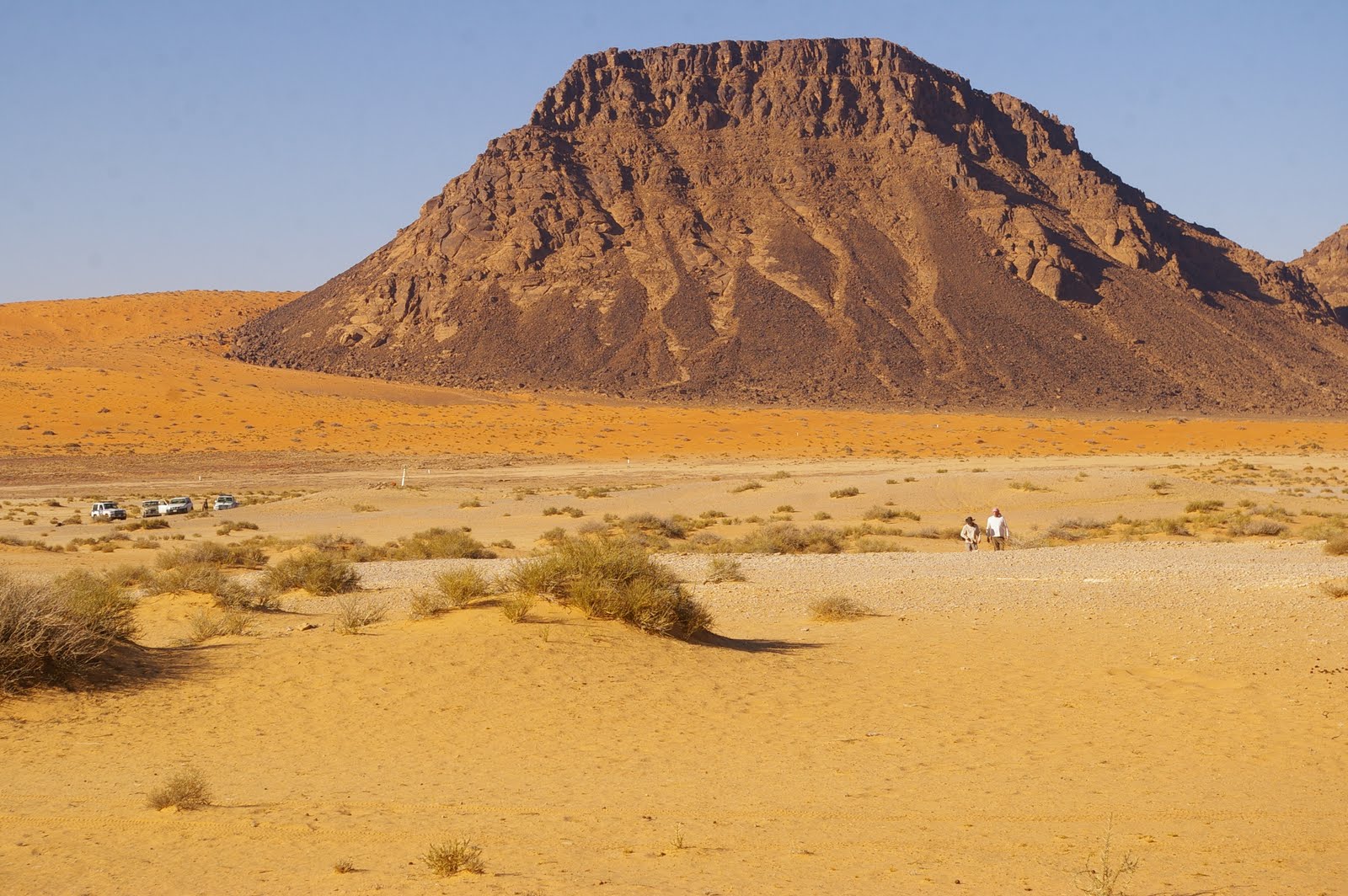
In March of this year a small team of interdisciplinary specialists conducted a pilot study in the palaeolake region of the Nafud Desert in northern Arabia. We concentrated our fieldwork in the Jubbah basin, since this area was known to contain a palaeolake, Palaeolithic and Neolithic sites, and an extraordinary amount of rock art. We were not disappointed in our choice of our survey area, since a few intensive days of work showed that the region contained a wealth of lakeside sites and rockshelters with artefactual material. We plan on conducting long-term field work in Jubbah to understand how humans adapted to changing environments over the last 125,000 years. We also plan on conducting field work on older Acheulean sites (with characteristic large stone tool forms known as handaxes and cleavers), which probably relate to much earlier exits of closely related ancestors, such as Homo erectus and Homo heidelbergensis.


The joint fieldwork programme is part of a 5 year agreement between the Saudi Commission for Tourism & Antiquities and the School of Archaeology, University of Oxford. Our initial fieldwork has been supported by a grant to Richard ‘Bert’ Roberts, “Monsoons and Migrations”, Australian Research Council.

Saturday, 15 May 2010

UK-Sri Lanka team explores Indian Ocean links


A new collaboration between a consortium of UK and Sri Lankan institutions has been initiated to study early maritime subsistence and trade in Sri Lanka. The collaboration brings together researchers and students from the universities of Oxford, UCL, and Ruhuna with the Post-Graduate Institute of Archaeological Research and the Sri Lankan Department of Archaeology. A first fieldwork season was recently conducted, investigating coastal midden and port sites, as well as inland shelters. The project aims to better understand the emergence of coastal communities, regional trade and long-distance contacts, though the application of a suite of new techniques to the extraordinary but still poorly known Sri Lankan record. Preliminary results are providing insights into the spread of crops and commensal species, as well as Sri Lanka’s role in the spice trade.

The project is being undertaken as part of the Oxford-based Sealinks Project and the UCL-based Early Rice Project. Students from the University of Ruhuna participated in an associated field school.